
Orbital Paradigm and Comat Sign Agreement to Explore Return-to-Earth Services for Biology Payloads
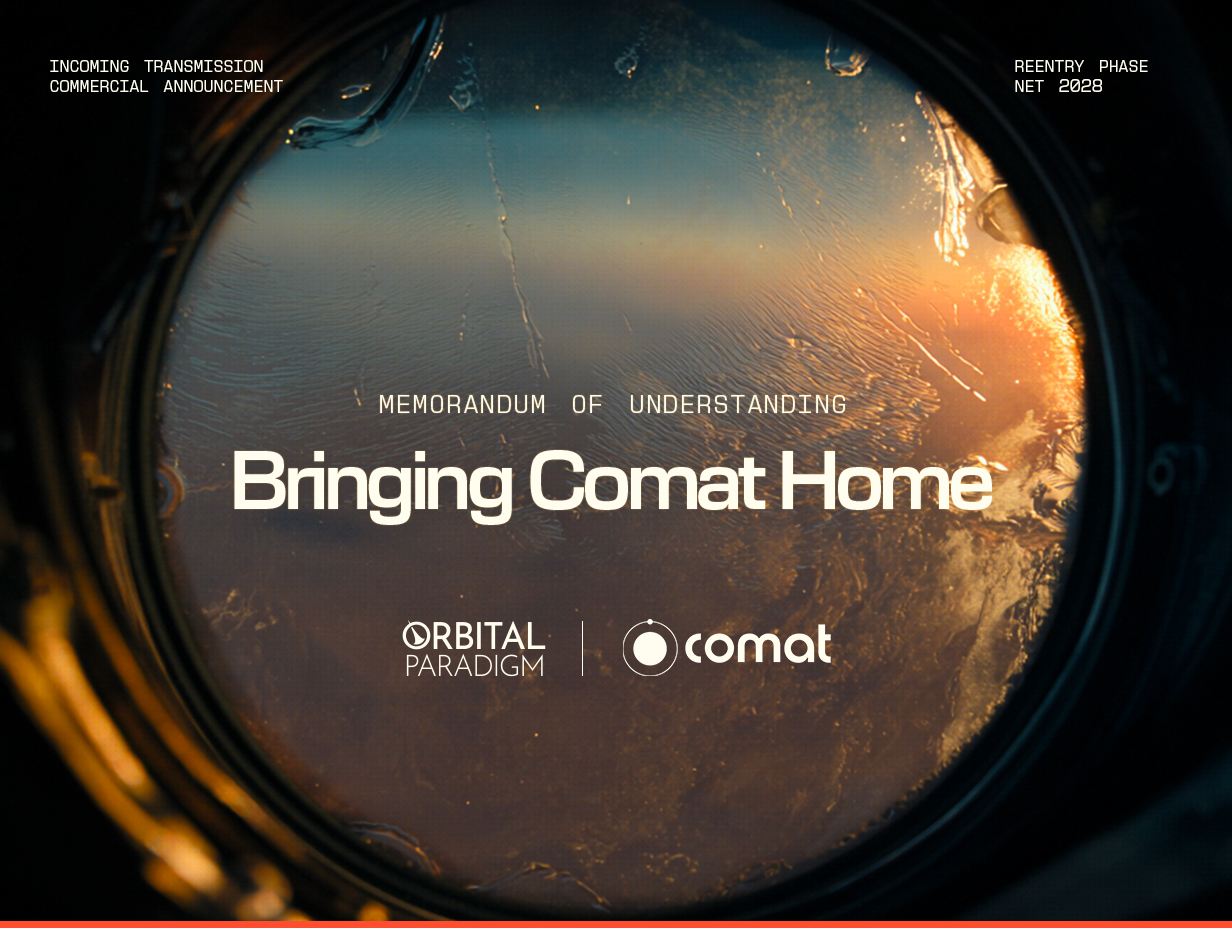
Madrid-based Orbital Paradigm and Toulouse-based Comat have signed a Memorandum of Understanding to explore future launch and return services for microgravity biology payloads. The agreement covers potential missions starting in 2028, including transport for Comat’s autonomous next-generation biology laboratory designed for post-ISS missions.
Comat has built biology and microgravity equipment for space since 1977. The company first designed science payloads for the MIR station and capsule FOTON, before designing and building KUBIK biological incubator for the European Space Agency, which has run over 60 experiments aboard the International Space Station since 2004. Comat, with its partner Kayser Italia, is now developing MARIN, a next-generation orbital biology laboratory backed by ESA, with a first launch planned from 2028. Such payloads require a vehicle capable of reaching orbit and operating the experiment in space, and, depending on the customer’s mission objectives, either returning samples to Earth or enabling in-orbit data analysis.
That need fits what Orbital Paradigm is building. The company launched its first capsule, KID, in january 2026. Despite a launch vehicle anomaly, the capsule survived extreme reentry at 28G and Mach 20, transmitting 190 seconds of valuable data. A second mission is planned for early 2027 with a larger capsule, and includes a recovery attempt. These flights support the development of Kestrel, the company’s reusable capsule built for regular transport and return of sensitive payloads by the early 2030s.
“Comat has operated biology hardware in orbit for half a century. They know what they need from a transport provider. Collaborating with them ensures that our reusable cargo capsules fit with the reality of the microgravity market”, said Francesco Cacciatore, CEO of Orbital Paradigm.
“MARIN represents a leap forward in autonomous orbital biology, designed to meet the challenges of the post-ISS era. Partnering with Orbital Paradigm allows us to work on a critical link in the chain: reliable, reusable return capabilities for our most sensitive experiments. This collaboration is about ensuring that the next generation of space biology delivers actionable results back on Earth.” says Jean-Loup CARTIER, Comat’s CTO.
The MoU establishes a framework for both companies to define mission parameters and timelines for potential services.
About Orbital Paradigm
Orbital Paradigm is a Madrid-based space-transportation company founded in 2023. It develops reusable in-space transport vehicles capable of returning to Earth. As first application, the company ships sensitive materials to space and returns zero-gravity experiments and manufactured products to the industries that need them. It launched its first capsule, KID, in January 2026, with a second mission planned for early 2027. These flights support the development of Kestrel, the company’s reusable return capsule designed to reach up to monthly operations in the early 2030s.
About COMAT
Founded in 1977, Comat is a French company specialized in the design and manufacturing of high-reliability mechanisms and equipment for the space industry. Headquartered in Toulouse, Comat supports major institutional and commercial space programs worldwide. Its portfolio includes reaction wheels, Solar Array Drive Mechanisms (SADM), deployable mechanisms, and other critical spacecraft subsystems.
With decades of flight heritage, Comat delivers robust, export-ready solutions for satellites and orbital platforms. The company combines engineering excellence with agile industrial capabilities to meet the evolving needs of the global space market.

This project has been funded by the Centre for the Development of Industrial Technology (CDTI), through the NEOTEC Programme, with the support of the Ministry of Science, Innovation and Universities and European Union funds – NextGenerationEU, under the Recovery, Transformation and Resilience Plan.
